
Thank you!Hi Mike:
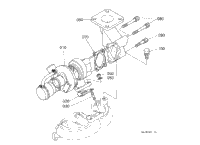
Things are looking really good. Quick question: What is the part number for the muffler flange that attaches the turbocharger to the exhaust manifold? I am having a hard time finding it. Thanks.
Solo
Ok, that's what I thought after going back and looking at some of the earlier pictures. So, are you using the waste gate on the turbo at all? The TD025 turbo has a max rotational speed of 240,000 RPM, so I would think that running at only 2100 RPM you wouldn't need it. Do you have any idea what speed the turbo is spinning?Thank you!
Much progress is being made.
We designed and fabricated the Turbo-to-exhaust manifold adapter. It’s a custom part and isn’t available through Kubota. I can get you one but, I don’t know if it’ll work for your application.
Mike
Yes, we are using the internal Turbo Actuator Pressure Wastegate that is present on the MHI Turbocharger (I can supply you with the Kubota part number for the Turbo if you like). I'd have to look up the specs on the Turbo again to verify the operating RPM (the Turbo is capable of producing 90HP). But, as far as the actuator wastegate goes, we are using manual adjustments to the actuator to adjust boost pressure.Ok, that's what I thought after going back and looking at some of the earlier pictures. So, are you using the waste gate on the turbo at all? The TD025 turbo has a max rotational speed of 240,000 RPM, so I would think that running at only 2100 RPM you wouldn't need it. Do you have any idea what speed the turbo is spinning?
Solo
Got it. So, the stock Kubota muffler flange that connects the turbo exhaust to the main exhaust pipe is pretty much a unicorn as far as I can tell from my research. I would really be interested in seeing what/how you milled a custom flange. Comparing it to the Kubota drawing, it has to be cut fairly deep to accommodate the waste gate when it dumps excess exhaust. Do you have any drawing or dimensions?Yes, we are using the internal Turbo Actuator Pressure Wastegate that is present on the MHI Turbocharger (I can supply you with the Kubota part number for the Turbo if you like). I'd have to look up the specs on the Turbo again to verify the operating RPM (the Turbo is capable of producing 90HP). But, as far as the actuator wastegate goes, we are using manual adjustments to the actuator to adjust boost pressure.
Having the ability to adjust/increase the boost pressure helps maintain a set HP goal while maintaining/decrease EGT temperature creep.
Mike
The OEM turbo outlet to muffler flange 'should' be available through Kubota for some applications that use the TD025 Turbocharger. However, will it work for your application? Hard to say.Got it. So, the stock Kubota muffler flange that connects the turbo exhaust to the main exhaust pipe is pretty much a unicorn as far as I can tell from my research. I would really be interested in seeing what/how you milled a custom flange. Comparing it to the Kubota drawing, it has to be cut fairly deep to accommodate the waste gate when it dumps excess exhaust. Do you have any drawing or dimensions?
Thanks for your patience - it is really appreciated.
Solo
Looking at the Kubota part, there is a very sharp upward turn that is most likely due to space constraints. I think I can find the gaskets, but if you can provide the thickness of your flange that would be an enormous help. I do have access to fabrication and assembly facilities.The OEM turbo outlet to muffler flange 'should' be available through Kubota for some applications that use the TD025 Turbocharger. However, will it work for your application? Hard to say.
We had to fabricate custom components to make the Turbo work for the L2501. Unfortunately, I don't have any drawings since all the piping and flanges were done by hand. Are you just looking for dimensions of the flanges? I can get you the OEM Kubota gaskets we used for the Turbo system. The gaskets would give you the dimensions of the flanges and I can provide the flange thickness.
Mike
We are using the following;Looking at the Kubota part, there is a very sharp upward turn that is most likely due to space constraints. I think I can find the gaskets, but if you can provide the thickness of your flange that would be an enormous help. I do have access to fabrication and assembly facilities.
Solo
Wow! This is Excellent! Thanks Mike, this is exactly what I was looking for. . .This may help too;
![]()
Kubota Tractor R420 S01100 Turbo Charger
Shop online for OEM S01100 Turbo Charger parts that fit your Kubota Tractor R420, search all our OEM Parts or call at 888-458-2682shop.kubotausa.com
Mike
I’ve never heard or seen a Kubota D1703 with top end issues caused by any performance enhancing modifications.I talked to a Kubota salesman who has been a mechanic. He said the bottom end of the 25hp engine is bulletproof. the top end, not so much. The engine can be hopped up to 28hp with no issues. What he says happens is the excessive pressures and heat crack the head or blow out the head gasket. The good news is if you crack a head a new ready to go chinesium head can be bought for under $500 on eBay.
I know 12 valve Cummins motors that get cranked up often end up with cracked heads.
Take the above information for what it is worth.
I thought you’d appreciate that!Wow! This is Excellent! Thanks Mike, this is exactly what I was looking for. . .
Solo
He was specifically talking about the L2501.I’ve never heard or seen a Kubota D1703 with top end issues caused by any performance enhancing modifications.
Did he specify which 25HP Kubota engine? There are quite a few in Kubota’s lineup over the years. Was he referring to the L2501 and the D1703 specifically? Does he have any experience with modified D1703 engines? Turbocharging? Or, was he simply talking out of his a$$?
Mike
You haven’t provided any details regarding the modifications to consider. What are we considering?He was specifically talking about the L2501.
He said his dealership had turned up engines in the past.
I just put it out there to consider.
Absolutely! The one thing I have found during my own preliminary research is how critical EGT monitoring is. I was shocked to see how fast and how high exhaust temperatures went up when the engine was loaded hard and started rolling coal. Black smoke = higher EGT's, plain and simple.You haven’t provided any details regarding the modifications to consider. What are we considering?
How were these tractors modified?
There are now several Turbocharged L2501’s running without issue for hundreds of hours.
There are even more L2501’s with injection timing modifications running without issues.
I’m trying to understand the purpose of your post?
I have read about ONE turbocharged Kubota tractor that had an engine issue after turbo installation. He melted his pistons after 400-500 hours of hard use. Ironically, he fixed his engine and reinstalled the crude backyard turbo setup.
I inquired about his specific setup several times trying to understand what led to his engine issue.
He was extremely reluctant to admit that he had ZERO knowledge of his combustion temperatures and didn’t have a pyrometer or EGT gauge installed on his tractor. He had no clue what temperatures he was running?!?
That’s plain negligence! You’re asking for trouble without knowing this critical engine health information! And, I’m surprised his engine lasted as long as it did.
You have to monitor EGT temperatures if you’re modifying your tractor! Period!
Mike
So, looking at your intake/exhaust pipe routing, I am kind of shocked at the huge size of the main piping, versus the pipe size connecting to the turbo. It looks like 3" diameter? Is there much gain in performance with the bigger pipe, considering the necked-down size into/out of the turbo? Puzzled.We redesigned the Turbo Intake Charge pipe so the factory Hood Prop Rod Absorber can function as intended;
View attachment 101009
View attachment 101010
View attachment 101011
This redesign was a necessity! Opening the hood was extremely awkward without the assist of the absorber and holding it up with a broomstick was utterly ridiculous.
Now, all is well!
We also added an extension to the Exhaust pipe exit to further send exhaust fumes away from the operator station.
I'll share some pictures of that modification soon.
Mike