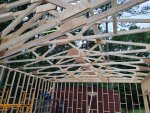
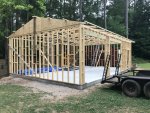
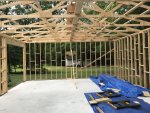
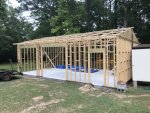
Still gonna put X-braces between the trusses, The whole thing moves a little bit when I’m playing monkey bars on it. Not much, but you’ll notice there’s no sheathing on it yet and only two diagonal braces on the back walls. Might put a little sheathing on it tomorrow, but only have 4 sheets of plywood at the moment.Looks great!
Man, that would even pass inspection in Coconino county, AZ!
(toughest building codes & inspections in the nation!)

Feels nearly that big standing in it. Didn't think 24 x 35 was all that large, but throw in 10 foot eave height (bottom of the trusses from the slab), and it feels huge with a top on it, even if it is just a tarp for now. But, huge is good. The missus is getting pretty excited about it, because she knows the next project is her kitchen, and now I'll have a place to store materials and work on it even in bad weather. I have a WIDE stair going up to my deck with 4 stringers (two cut between two solid) that I could probably climb with the Kubota, so easy access to the back door which is right next to the kitchen. That'll make bringing in larger cabinet assemblies a little easier. Just have to cross the yard and climb one flight of stairs(14 steps). My rear deck is at least 10 feet high, if not 12 at the outer edges. Like everything else that I do, it's overbuilt. I don't like moving decks.Looks like a nice Noah's Ark there my friend.![]()
![]()
That’s actually a brilliant idea. Would help insulate a little bit by creating air pockets and reflecting heat when I put the wood stove in. Gonna have foam underlayment with vinyl siding outside, so don’t anticipate horrible conditions inside. Have 3/4 inch foam panels under the siding on the old shed that I can repurpose as well. Some will find its way to my home brew hobby as well so I can make a lagering chamber to expand my brewing skills. Just hope the shed builder didn’t glue the panels to the studs. Don’t need a lot of heat here, but concrete floors can suck a lot of body heat out of an old man like me. I ain’t as tough as I once was, but I’m as tough once as I ever was. Was just gonna scrap the siding at the local recycling center and use the old flooring for custom peg/tool boards and make lean-tos out back to store fire wood as I clean the lot. I think I’ll put the wainscoting at least 6 feet high around a welding area(probably the center bay) and start collecting old pallets for siding like you have too. Nice looking work, btw. I like the appearance of the rough boards inside. I like the idea of roughing the inside a bit while keeping the polish on the outside.Nice build, you're a lot like me in that you save stuff from other projects to build new stuff.
You should re-use the aluminum siding from the old shed on the walls inside your new shed. Might look nice as a wainscotting.
Or if you plan to do some metal working in there it's nice to have something fire proof on the walls where you grind and cut metal. I was in a similar situation in a small workshed I just built. I lined the walls with plywood strips I got from a custom concrete company that used them a forms. I was worried that the sparks from metal working would catch either the plywood on fire, or get between the cracks and catch the paper face of the insulation on fire. Luckily I had some oddball metal roofing that I was kicking around and almost threw out. So I cut it down and lined the back of my workbench with it to catch the sparks.
I have bad knees and feet so when I'm working on the concrete I get pretty sore. At my last house I reused the laminate floor (the easy wood looking click together stuff) from our kitchen remodel and laid out an area over the concrete in my garage to work on, helped a ton! I also didn't have enough of the special underlayment to use with it, so I just used tar paper to keep the moisture from the concrete from warping it. The laminate was a softer and warmer surface to sit/lay down on while working on something, also helped to cushion a little while standing. Only downside is the flooring doesn't like to get be soaked in water or fluids, but the upside is it's cheap to replace and can sometimes be had for free. I did the whole floor in my workshed with it, only cost me $150 though it's only 325 square feet. You could always lay out an area with the old flooring from your existing shed as a work surface, just put tar paper under it so the moisture doesn't bother it.but concrete floors can suck a lot of body heat out of an old man like me.
You can always make a small welding booth with sides on it and then use a bathroom fan to ventilate it. Anything is better than nothing and bathroom fans are cheap and already set up to ventilate somewhere else. Run the duct for it to a vent in your soffit to get the fumes out, that's what I'm going to do next in my workshop, just didn't get the chance to run the wiring and duct yet and it's too hot in the attic for me to crawl up there now.I have a flux core welder that I either ventilate, or let it kill me. I don’t like the latter option. I see a welding vent in my future.
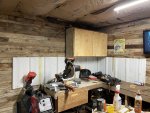
Thanks. I actually got really lucky with these boards. They were forms from a custom concrete company close to work. They would cut the forms out of 5/8" plywood and then let them and the scraps sit outside stacked on a pallet for years. They were moving locations so they sold off a bunch of stuff. I got 4 or 5 pallets of these plywood strips for $20 a pallet. 95% of the strips were 8 feet long and each pallet was stacked 4 feet deep and 4 feet high. Had no use for it at the time, but knew I'd use it as wallboard somewhere. I saved the ones that were consistent width to use in our garage so it looks like shiplap.Nice looking work, btw. I like the appearance of the rough boards inside.
I put a moisture barrier (plastic sheeting) under the slab. If there's anything I've learned about moisture barriers in the past couple weeks, it's that they work both ways. Thus the squeegee purchase. I've pushed at least 1000 gallons of water off my slab in the past week alone. We've had a lot of rain, and there's no end in sight. The Noah's Ark comment may be closer to the truth than I really want to think. I'll keep the laminate idea in mind. Got plenty asphalt felt. Bought a roll to put a moisture barrier between the bottom plate and the slab, but in order for that to work, I gotta stop the rain from coming in. Picked up the roofing materials today. I need to put the final tweaking on the squaring and plumbing of the frame, as well as put up the PVC facia, then I can start on the roof. Only 24 sheets to install, but can't do that when it's pouring down rain and lightning is popping everywhere. I put a blue tarp on it to keep the trusses I made from coming apart. The OSB and plywood I used to make the gussets showed a bit too much water absorption. I wasn't a happy camper when I saw that. I think it'll still pass inspection, but I should have put the tarp on it a lot sooner than I did. It only took one day of rain to do the damage. I have no interest in taking those trusses back down to repair them. I've been struggling to progress with it the last couple days because of rain. But, I did manage to get the lighting and outlet circuits completed. Hoping to start putting the roof on this weekend, weather permitting. I still need about 25 more sheets of sheathing to put on the sides. I may just bite the bullet and cover that with asphalt felt to keep it dry until I can get the underlayment and vinyl siding on it. It ain't fun fighting battles with Mother Nature. I don't want to spend the extra for marine grade plywood to keep it from coming apart. I don't ever remember seeing this much rain in June before. We had 6.5 inches in ONE DAY last week. There must have been at least 4 inches yesterday. There's no question that I'll have to install gutters to control the erosion around this thing.I have bad knees and feet so when I'm working on the concrete I get pretty sore. At my last house I reused the laminate floor (the easy wood looking click together stuff) from our kitchen remodel and laid out an area over the concrete in my garage to work on, helped a ton! I also didn't have enough of the special underlayment to use with it, so I just used tar paper to keep the moisture from the concrete from warping it. The laminate was a softer and warmer surface to sit/lay down on while working on something, also helped to cushion a little while standing. Only downside is the flooring doesn't like to get be soaked in water or fluids, but the upside is it's cheap to replace and can sometimes be had for free. I did the whole floor in my workshed with it, only cost me $150 though it's only 325 square feet. You could always lay out an area with the old flooring from your existing shed as a work surface, just put tar paper under it so the moisture doesn't bother it.
I already have a small squirrel cage fan that I think was a booster fan for a forced draft furnace. Fans are pretty easy for me to get hold of. Got a couple ideas/options I'm kicking around for getting rid of welding fumes. For now, just have to make sure I never weld with the doors closed.You can always make a small welding booth with sides on it and then use a bathroom fan to ventilate it. Anything is better than nothing and bathroom fans are cheap and already set up to ventilate somewhere else. Run the duct for it to a vent in your soffit to get the fumes out, that's what I'm going to do next in my workshop, just didn't get the chance to run the wiring and duct yet and it's too hot in the attic for me to crawl up there now.
Send some up my way to WI, we're really dry here now and need rain bad.....though that just brings in the Mosquitos.I don't ever remember seeing this much rain in June before. We had 6.5 inches in ONE DAY last week. There must have been at least 4 inches yesterday. There's no question that I'll have to install gutters to control the erosion around this thing.
Not sure about the codes by you, but we've built houses before with this stuff for wall sheathing. I'm tempted to go this route on my shed build this summer just to help save cost. We hated using it because it just seemed silly to use when OSB was just as cheap. Biggest thing when using this type of stuff (and/or the insulation board alternative) is you have to inlay diagonal bracing in the corners to create the stiffness for the wall. That was the biggest pain setting that stuff in. Sometimes we cheated and used OSB on the corners and then this stuff or insulation board for the rest of it. My old house was sided with this stuff and it was built in '79 and still standing like me.I still need about 25 more sheets of sheathing to put on the sides.
Great idea! And likely more airflow than a bathroom fart fan.I already have a small squirrel cage fan that I think was a booster fan for a forced draft furnace. Fans are pretty easy for me to get hold of. Got a couple ideas/options I'm kicking around for getting rid of welding fumes. For now, just have to make sure I never weld with the doors closed.
Some of the skeeters around here have tail numbers and appear to be armed with sidewinder missiles. The scorpions are even trying to find a place to get outta the rain here. Had one about an inch and a half long come visit me while I was framing the east wallSend some up my way to WI, we're really dry here now and need rain bad.....though that just brings in the Mosquitos.
OSB and 3/8 plywood sheathing is about the same price right now. Hard to figure that out considering OSB is mostly the waste product of making plywood. I’m pretty frugal with my lumber purchases. Until today, I don’t think I had more than 1% waste. But I blew up that statistic because I screwed up cutting a sheet of plywood and now have to figure out how to use it elsewhere. Probably some doors for some workbenches I already have to keep some of the dust outta less frequently used toolsNot sure about the codes by you, but we've built houses before with this stuff for wall sheathing. I'm tempted to go this route on my shed build this summer just to help save cost. We hated using it because it just seemed silly to use when OSB was just as cheap. Biggest thing when using this type of stuff (and/or the insulation board alternative) is you have to inlay diagonal bracing in the corners to create the stiffness for the wall. That was the biggest pain setting that stuff in. Sometimes we cheated and used OSB on the corners and then this stuff or insulation board for the rest of it. My old house was sided with this stuff and it was built in '79 and still standing like me.
Yeah, I want to put temperature controlled ventilation fans in the gables to help cool the shed some. But I don’t want to make welding fume remove part of the job for those.Great idea! And likely more airflow than a bathroom fart fan.