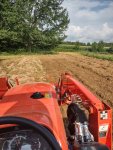
A long-time friend of mine has a home repair/remodeling business about 40 miles south of me. I'm retired and doing little more than teaching my chickens to play piano and do trigonometry, so I help him out on occasion for little more than boredom relief as pay. He introduced me to a retired doctor, who impressed the heck out of me. She's 94, still does ballet, can do a standing split, cuts her own grass, and tends at least 20 farm animals that she uses in up to 3 magic shows every year. But recently, she's had triple hernia surgery (I'm guessing from over exertion) and a few years ago fired the guy she had managing her pastures on a 32 acre property. As you might guess, they've grown up from neglect and are in dire need of management, so I sorta volunteered one day a week to get them caught back up.
The first field was nearly 6 acres and is a mix of just about any kind of grass you can think of, and a whole lot of cross-pollinated varieties that are THICK, especially in the bottoms of the hilly land. This has been my first experience with a flail mower in grass, and I'm still wondering if I'm doing it wrong. What I found is that tall grass and hammer flails don't particularly like each other. The grass tends to build up on the hammers and start pushing the grass over rather than cutting it. I have the option to switch to Y blades (the mower came with both), but there's also some 2-3 year old sapling growth scattered about that the hammers will do a much better job on. The problem is, it's a very time-consuming job to switch between them, so swapping blades back and forth is not really an option. I need the hammers for major cleanup, but think the Y blades will serve better in 'pasture grass' once I get it knocked down.
What I found works best is to make a half-swath pass in one direction, turn around and go right back where I came from cutting a half swath in the opposite direction. It's a very slow way to cut, but I'd need a much bigger tractor and mower to do it any other way. This also seems to clean it up a lot better than simply going the same direction multiple times. Basically, it results in the field being cut twice by the time I finish with it. It's a slow go, but not a bad finish for overgrown fields. There's plenty dewberry and black berry briars to go with the thick grass, and of course, near the fence, mower beware. The fence rows are like a box of chocolates because the previous guy that mowed them for her just kept getting farther and farther from the fence because he couldn't be bothered cutting the limbs back and cleaning up as he went. I didn't make a full lap before I found some heavy gauge electric fence wire and wrapped about 50 feet around the flail drum. An angle grinder turned out to be my best friend for a remedy because the wire was fairly large gauge steel wire with a fiberglass sleeve. Got that cut out, and was nearly done with the field (about 10 hours later) when I found something equally evil. Apparently, someone that the owner let board a couple horses used large round bales to feed them. I really don't think she knew what she needed to know about large round bales and horses. First of all, large bales tend to mold LONG before they're consumed by a couple horses. If the horse owner is lucky, and the horse gets picky, they won't eat it. If they aren't lucky, they find their horse laying on it's side dying. Horses and mold do not mix and hay left in the elements is going to mold. Unavoidable. Secondly, the bales provided were apparently wrapped with some kind of nylon or polyethylene mesh, which the horse owner or feed supplier didn't bother to remove and get out of the pasture. I'll give you 3 guesses what I found when I hit a large patch of deep Bermuda grass, and the first two don't count. I just thought the electric fence wire was bad. It took a while to cut that mess out of the mower because it wrapped very tight. Making bad worse, I made two more laps and found another big ball of the stuff. That's TWO. It was getting late, and we wanted to check out an overgrown road (with pines up to 4 inches in diameter growing in it) so I cut my way over to that had a go at what I thought I could chew up with the flail, then went back and loaded up to come home. Next morning, there's a THIRD hairball under my mower and I ain't happy. IMO, ANYONE that uses synthetic non-biodegradable mesh to bale with should be beaten with a stick. A big stick. Maybe a stick with "Louisville Slugger" branded in the side of it. That stuff should be outlawed on the planet. It's extremely dangerous for livestock to ingest it, never mind the dangers it poses to any wildlife that gets tangled up in it. The lady that owns it has at least a dozen geese, 4 donkeys, and a horse and no telling how much wildlife roaming the property.
Ennyhoo, I started the second field yesterday which is approximately 12 acres, and my guess is it's gonna take at least 3 days to clean it up again. According to my buddy, "It's not quite as thick". WRONG. Just as thick, if not thicker in the bottoms with a mix of Bahia, Bermuda, Johnson and even Centipede grasses. Tree limbs were hanging over the fence at least 30 feet out from the fence. And what else do I see? At least 5 spots where large round bales have been put out for feed. That's just the ones I could see, and I'm paranoid about how many have grown over. I cut until I got close to the first one, and then I used the grapple to scrape up all the old hay and the giant hairball of wrapping that was very well hidden in the grass. I also created an enormous brush pile from all the stuff we cut off the fence rows. The little old lady's horse started following us around, and while I was trying to figure out a repair in a corner, the horse nuzzled me and knocked me down. Just being friendly and curious, though, completely unintentional. The horse acts like a very large lap dog wanting attention. We got about 2/3 of the fence line cleared enough to see the fence from the inside and maybe about 1/3 of the field cut yesterday.
It's been a long time since I've spent those kinds of hours on a tractor and had completely forgotten how therapeutic it can be. I was tired, but relaxed and felt pretty good about what I was doing. Not doing it for the money so much as just trying to give back a little of what life has given me.
For now, I'm going down every Monday until I get it all cut down the first time, and will try to get her to let me cut it again before it gets so wild so that maybe it will improve the quality of the pastures for her animals as well as make the place look a lot better. It was a beautiful place at one time, but gonna take some effort to restore it. She has an old L3130 with a 5 foot RC behind it, but there's places that I prefer my LX2610 with 4WD and loaded tires along with the grapple for some of the clean up work. I also like the hydrostatic transmission that lets me slow down the travel speed a bit when I get in the really thick stuff. I nearly stalled the tractor with the mower twice in the thicker places. Her old L3130 is a manual transmission, and I'd wager the blades on the RC haven't been sharpened in at least 10 years. Needless to say, I don't think it would do much better than my little 4 foot flail as far as getting it cut down any faster, and the wear and tear on the clutch would be miserable. I can swap ends pretty quickly on the LX with no shifting. I just cut some headland along the fence rows, and a quick 3 point turn gets me on my way back to where I came from. Some places I can turn around without backing up at all because the flail is so short and I don't have to worry about taking out the fence with it.