
Anybody good at math out there?

MapleLeafFarmer

Well-known member

Equipment
Lots incl. B and L kubotas
Dec 2, 2019
1,095
1,090
113
E.
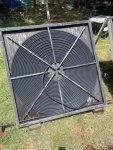
Can anybody estimate for me how much space I would need to take a 250 foot roll of 1 1/4 poly pipe and wrap it like the picture?
 

Attachments

Sidekick

Well-known member

Equipment
Kioti CK2620SE cab, RTV-X, BX2360, Z726XKW-3-60
Jul 29, 2023
1,211
1,744
113
N.Y,
AI should give a fast accurate answer.
 
  • Haha
Reactions: 1 user

McMXi

Well-known member
Lifetime Member

Equipment
***Current*** M6060HDC, MX6000HSTC & GL7000 ***Sold*** MX6000HST & BX25DLB
Feb 9, 2021
8,359
11,750
113
Montana
Can anybody estimate for me how much space I would need to take a 250 foot roll of 1 1/4 poly pipe and wrap it like the picture?
If you want to do the math yourself this should work for a decent estimate for the diameter of the coiled pipe which would be one side of the square:

(PI/4)*(d^2)=250ft*O.D. (pipe)

d=sqrt([4*(250ft*O.D.)]/PI)

For schedule 40 PVC pipe with an O.D. of 1.66" that would result in a "square" of approximately 80" or a little over 6-1/2 ft.

1-1/4" IPS SDR11 PE4710 Black HDPE Pipe has an O.D. of 1.66" as well.
 
Last edited:
  • Like
Reactions: 1 users

PoTreeBoy

Well-known member
Lifetime Member

Equipment
L35 Ford 3930
Mar 24, 2020
3,741
2,312
113
WestTn/NoMs
If you want to do the math yourself this should work for a decent estimate for the diameter of the coiled pipe which would be one side of the square:

(PI/4)*(d^2)=250ft*O.D. (pipe)

d=sqrt([4*(250ft*O.D.)]/PI)

For schedule 40 PVC pipe with an O.D. of 1.66" that would result in a "square" of approximately 80" or a little over 6-1/2 ft.

1-1/4" IPS SDR11 PE4710 Black HDPE Pipe has an O.D. of 1.66" as well.
I like your method. You got the right answer, but don't show multiplying 250' by 12 to get inches. Consistent units, you know :).
 
  • Like
  • Haha
Reactions: 1 users

McMXi

Well-known member
Lifetime Member

Equipment
***Current*** M6060HDC, MX6000HSTC & GL7000 ***Sold*** MX6000HST & BX25DLB
Feb 9, 2021
8,359
11,750
113
Montana
I like your method. You got the right answer, but don't show multiplying 250' by 12 to get inches. Consistent units, you know :).
I thought AI was taking care of that! 😂
 

chim

Well-known member

Equipment
L4240HSTC with FEL, Ford 1210
Jan 19, 2013
3,229
2,908
113
Near Lancaster, PA, USA
Based on an Xcel calc, the pipe would make about a 8-1/2' OD circle using an ID of24" (if you can do it that tight) 23 wraps of 1.66" pipe.
 
  • Like
Reactions: 1 user

McMXi

Well-known member
Lifetime Member

Equipment
***Current*** M6060HDC, MX6000HSTC & GL7000 ***Sold*** MX6000HST & BX25DLB
Feb 9, 2021
8,359
11,750
113
Montana
Based on an Xcel calc, the pipe would make about a 8-1/2' OD circle using an ID of24" (if you can do it that tight) 23 wraps of 1.66" pipe.
If you wanted to calculate it you'd simply add the square of the inner diameter (hole) in the numerator of the square root term.

So is a 24" diameter for the first loop reasonable? With the addition of heat you could probably get a tighter coil.
 

chim

Well-known member

Equipment
L4240HSTC with FEL, Ford 1210
Jan 19, 2013
3,229
2,908
113
Near Lancaster, PA, USA
I'm sure there are more advanced ways to do it, but it's been a long time since math class. Since the late 60's most calculations for me have been related to electrical power. I took (for me) the easy route. Look up the pipe OD, figure that 24"Ø is about as small as that pipe wanted to be coiled (I battled a 300' coil of 1" ID when we built our place), added twice the OD for each successive wrap and left it up to Xcel.

Oops - As noted by McMXi there was an error in the sheet.
 
Last edited:

Scm

Well-known member

Equipment
BX23S
Sep 28, 2024
352
363
63
Missouri
Some additional info for your project. I love this site but it has not updated in a long time. Still useful though


McMXi

Well-known member
Lifetime Member

Equipment
***Current*** M6060HDC, MX6000HSTC & GL7000 ***Sold*** MX6000HST & BX25DLB
Feb 9, 2021
8,359
11,750
113
Montana
I'm sure there are more advanced ways to do it, but it's been a long time since math class. Since the late 60's most calculations for me have been related to electrical power. I took (for me) the easy route. Look up the pipe OD, figure that 24"Ø is about as small as that pipe wanted to be coiled (I battled a 300' coil of 1" ID when we built our place), added twice the OD for each successive wrap and left it up to Xcel.

View attachment 175232
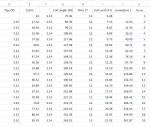
Looks like your Coil D column increments by 1.66 rather than 3.32. :unsure:
 

GreensvilleJay

Well-known member

Equipment
BX23-S,57 A-C D-14,
Apr 2, 2019
13,768
6,246
113
Greensville,Ontario,Canada
Can anybody estimate for me how much space I would need to take a 250 foot roll of 1 1/4 poly pipe and wrap it like the picture?
The sad thing is ,after doing all that work, you won't get a lot of heat out of the collector. Very little surface area for the sun to heat up. BTDT 25 years ago. went with proper flat 'corrugated' panels ( 3 x 4x12 units ) to heat my 15' above ground.it'd easily heat to 84*F on a sunny day.
 

chim

Well-known member

Equipment
L4240HSTC with FEL, Ford 1210
Jan 19, 2013
3,229
2,908
113
Near Lancaster, PA, USA
Years ago I saw an installation where the owner simply fastened his black pipe on the exterior of a South-facing fence. It ran horizontally in many rows on the wood fence. The fence was one of those made in sections with thinner horizontal pieces of wood giving it a woven appearance. That may provide more square inches of pipe exposed to the sun that making it into coils that could shade each other.
 

McMXi

Well-known member
Lifetime Member

Equipment
***Current*** M6060HDC, MX6000HSTC & GL7000 ***Sold*** MX6000HST & BX25DLB
Feb 9, 2021
8,359
11,750
113
Montana
Arrgh. You're right. Although I SAID I added twice the OD - I didn't:mad:

I THINK This one is correct (but I also thought the earlier one was) :)

View attachment 175239
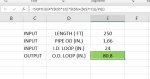
If you put the formula I showed above into Excel it's a lot simpler, cleaner and way more efficient. You can output any length, pipe O.D. and starting diameter by changing the values in thee cells.

Of course, we're talking about very simple geometries here, but as the geometry becomes more complicated that's where calculus starts to become useful.

pipe_calc.jpg
 
  • Like
Reactions: 1 user

McMXi

Well-known member
Lifetime Member

Equipment
***Current*** M6060HDC, MX6000HSTC & GL7000 ***Sold*** MX6000HST & BX25DLB
Feb 9, 2021
8,359
11,750
113
Montana
I used to enjoy listening to Click and Clack every Saturday and they'd have some interesting math problems. I remember a truck driver calling in and asking where to put the marks on a dipstick he'd made for the fuel tank to show 1/4 full and 3/4 full. The tank was a metal cylinder laying on its side which is typical for tractor/trailer type trucks.

The practical solution was to measure the diameter and length to get the volume, then add 1/4 the volume and mark the stick. Then add half the volume and mark the stick again but this time to show 3/4 full. The math solution was more interesting and easy to solve using calculus. I don't think I ever thought of a geometric solution but there probably is one.
 

chim

Well-known member

Equipment
L4240HSTC with FEL, Ford 1210
Jan 19, 2013
3,229
2,908
113
Near Lancaster, PA, USA
If you put the formula I showed above into Excel it's a lot simpler, cleaner and way more efficient. You can output any length, pipe O.D. and starting diameter by changing the values in thee cells.

Of course, we're talking about very simple geometries here, but as the geometry becomes more complicated that's where calculus starts to become useful.

View attachment 175272
That's cool but way beyond my Excel capabilities:)

I was also a fan of the Tappet Brothers. One of our VP's had an accent and sense of humor that would have let him fill in for one of them.
 

Mark_BX25D

Well-known member

Equipment
Bx25D
Jul 19, 2020
2,093
1,598
113
Virginia
If you put a glass cover over it you'll get a lot more heat.

But at 8.5 feet in diameter, that might be a bit expensive....

But putting some insulation behind it will make a noticeable difference, too, and would not be expensive. Use 1" foam with a foil surface and you'll gain a lot.