
Strange Blade

chim

Well-known member

Equipment
L4240HSTC with FEL, Ford 1210
Jan 19, 2013
3,014
2,505
113
Near Lancaster, PA, USA
Made some headway today. Some weather forecasts say snow is coming so having parts scattered in the yard isn't good. As mentioned in a previous post, the utility trailer has been designated as storage/workbench for the blade refurb. (Not happy with the Ford's hitch but that'll be another story).

First thing was to get the pieces gathered and loaded. The blade itself weighs a lot more than I can toss on the trailer. Since the Kubota is tied up with the snow plow, it was an opportunity to try the winch mount. A couple years ago when the utility trailer was freshened up I added provisions for a small HF winch. It's just a pair of steel flat bars that stick up so a pin goes through what would be the pin hole when it's in a 2" receiver. The winch plate sits one post that aligns the cable with the space between the lower boards. Rigged face-down with the sling under it made the blade almost load itself. For a one-man operation like this the wireless remote worked well. When the blade got right to the trailer I did slip a scrap of PVC T&G under it to help it slip over the edge.
 

Attachments

Last edited:
  • Like
Reactions: 1 users

chim

Well-known member

Equipment
L4240HSTC with FEL, Ford 1210
Jan 19, 2013
3,014
2,505
113
Near Lancaster, PA, USA
After loading, the trailer was taken closer to the tools. Where pins went though hollow steel parts they were sleeved. Seemed like a good idea, but most were in poor condition. The first two pictures are of the lower part of the piece I started working on in Post #11. The larger sleeved hole on the right was in decent shape. It's where the "stem" of the blade passes through. The smaller hole to the left is for the pin for the tilt adjustment. Its sleeve was in poor condition. I rigged the mag drill to cut the old sleeve out.

x4.jpg x8.jpg


Then I moved on to the frame that holds the blade itself. That was a chance to use the old Milwaukee die grinder. It made short work out of cleaning up the two bottom holes. Large one is for the shaft/axle the blade rotates on and the smaller hole is for the rotation pin. You can see how "wallered out" the bottom pin hole is even tough it has a sleeve. The sleeve was pretty much gone on the bottom end. This blade must have had a hard life.

x5.jpg x6.jpg

The mag drill was used again to cut the top of the sleeve loose. It's magnet has it stuck onto a piece of 1/2" steel plate that is clamped in place with a big C-clamp and short bar clamp that are on the other side of the drill.


x7.jpg
 

Attachments

  • Like
Reactions: 1 users

Runs With Scissors

Well-known member

Equipment
L2501 TLB , Grappel, Brush Hog, Box Blade, Ballast box, Forks, Tiller, PH digger
Jan 25, 2023
3,538
4,642
113
Michigan
After loading, the trailer was taken closer to the tools. Where pins went though hollow steel parts they were sleeved. Seemed like a good idea, but most were in poor condition. The first two pictures are of the lower part of the piece I started working on in Post #11. The larger sleeved hole on the right was in decent shape. It's where the "stem" of the blade passes through. The smaller hole to the left is for the pin for the tilt adjustment. Its sleeve was in poor condition. I rigged the mag drill to cut the old sleeve out.

x4.jpg x8.jpg


Then I moved on to the frame that holds the blade itself. That was a chance to use the old Milwaukee die grinder. It made short work out of cleaning up the two bottom holes. Large one is for the shaft/axle the blade rotates on and the smaller hole is for the rotation pin. You can see how "wallered out" the bottom pin hole is even tough it has a sleeve. The sleeve was pretty much gone on the bottom end. This blade must have had a hard life.

x5.jpg x6.jpg

The mag drill was used again to cut the top of the sleeve loose. It's magnet has it stuck onto a piece of 1/2" steel plate that is clamped in place with a big C-clamp and short bar clamp that are on the other side of the drill.


x7.jpg
Good job man!

Gotta love that mag drill!

Those holes would have been a Sum-Bitch to drill without it.

I am especially intrigued by your “mobile base plate” that you have for it……I might have to rig something like that up for myself. :unsure:
 

chim

Well-known member

Equipment
L4240HSTC with FEL, Ford 1210
Jan 19, 2013
3,014
2,505
113
Near Lancaster, PA, USA
The mag drill is one of those tools that doesn't get used with every project. It is often the best thing for some applications. Using it sometimes requires a little thought because of the way it mounts. I made up the piece of steel with a large hole that works in many cases. Sometimes a simple piece of steel works, as the pic below where I'm drilling a thick wood column at my BIL's. Two of the spots it was used on the blade project needed to have a scrap piece of steel plate shimmed to get around a small second thickness of existing material (one with a second plate and the other with a piece of 1/2" allthread.

EDIT TO ADD for mag drill noobies: The material it's anchored to needs to have some thickness to it. The 1/4" thick plate with the hole is MINIMUM. With that plate if you get too aggressive with the feed it can act like a jack on the magnetic base and break it loose.
 

Attachments

Last edited:
  • Like
Reactions: 1 user

chim

Well-known member

Equipment
L4240HSTC with FEL, Ford 1210
Jan 19, 2013
3,014
2,505
113
Near Lancaster, PA, USA
Ahhh, nice enough weather today to get more work done on the blade. And why does my welding table always end up looking like a homeless encampment? There wasn't any 1/2" plate here that would yield an 8" x 12" piece. Fortunately there was a rogue length of 1/2" x 6" flat bar that could be "rearranged" by the Everlast.
 

Attachments

  • Like
Reactions: 3 users

chim

Well-known member

Equipment
L4240HSTC with FEL, Ford 1210
Jan 19, 2013
3,014
2,505
113
Near Lancaster, PA, USA
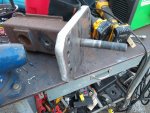
We had some balmy 20°'s today and I couldn't resist laminating the new lock plate onto the old one. One step closer. The corners of the new plate were trimmed off at 45° to match the original. Both plates had a hefty bevel ground on them and then they were glued together with 7014 at 130A. Some flap disc action and it looks OK (well, at least to me).

Question for someone more knowledgeable - Should I weld the gap between the 1-1/4" GR8 bolt and the plate? I have the head of the bolt welded to the underside of the bushing that was used to plug the hole in the "before" photo. The new plate has >1/8" clearance between it and the bolt.

Two things I was thinking about were (1) does it really matter if the clearance remains, or would it possibly contribute to a future failure? and (2) is it probable that heat from welding the plate to the bolt is an issue?
 

Attachments

  • Like
Reactions: 1 user

Runs With Scissors

Well-known member

Equipment
L2501 TLB , Grappel, Brush Hog, Box Blade, Ballast box, Forks, Tiller, PH digger
Jan 25, 2023
3,538
4,642
113
Michigan
And why does my welding table always end up looking like a homeless encampment?
Hahaha……..that made me LOL…..I have have a similar “encampment problem"


My "gut reaction" to your next post………..I would probably weld it.

I don't have any qualifications to back up my reasoning, but it seems that welding it might prevent some “wiggling” of the bolt…..and thus maybe a future bolt breakage from “fatigue”?

Although I’m not sure it would break in our lifetimes, cause that is a pretty “stout” bolt…...so theres that too. (y)
 

chim

Well-known member

Equipment
L4240HSTC with FEL, Ford 1210
Jan 19, 2013
3,014
2,505
113
Near Lancaster, PA, USA
Welding table - It could probably never be big enough. Normally there are three grinders (Battery w/flap disc, battery w/wire brush for cleaning and slag removal and corded with grinding wheel for wholesale metal removal). Then all the misc. hand tools and consumables.

I was also thinking it would be good to eliminate "wiggling" but I have a limited understanding of how the heat might affect it. Someone with more experience than I might recommend pre and/or post heat. I've cobbled lots of stuff without failures. At 76 I did decide that worrying about anything rusting through is not necessary:)
 

hedgerow

Well-known member
Jan 2, 2015
441
426
63
Malcolm NE
If I was doing the work I wouldn't weld that bolt to that plate. I have seen were folks had welded the bolt to the plate and the bolt sheared off at a later date. It will probably never break if you weld it but some 20 below cold morning you catch a rock or curb pushing snow is when it would break.
 

JohnDB

Active member
Lifetime Member

Equipment
M4500DT with FEL, back blade, Someca K28 hay mower, drag broom, post driver
Jun 9, 2018
517
142
43
NZ
If I was doing the work I wouldn't weld that bolt to that plate. I have seen were folks had welded the bolt to the plate and the bolt sheared off at a later date. It will probably never break if you weld it but some 20 below cold morning you catch a rock or curb pushing snow is when it would break.
Agreed, if @chim used grade 8 for it's strength, then welding the shank will weaken it substantially.
 

McMXi

Well-known member
Lifetime Member

Equipment
***Current*** M6060HDC, MX6000HSTC & GL7000 ***Sold*** MX6000HST & BX25DLB
Feb 9, 2021
7,467
10,342
113
Montana
This is a really good thread! (y) It has all of my favorite things going on. Steel, repairs, upgrades, welding, mag drills, tractors etc.

I was using the Buhler/Farm King 8ft blade yesterday to remove more dirt from the new driveway and wondering whether I should switch it out for the EA box blade, but it occurred to me that you can't create windrows of dirt with a box blade. Creating a windrow and then using the loader/bucket to move the dirt from A to B seems more efficient than filling up the box blade, backing up and scooping.

buhler_farm_king_12.jpg
 

chim

Well-known member

Equipment
L4240HSTC with FEL, Ford 1210
Jan 19, 2013
3,014
2,505
113
Near Lancaster, PA, USA
The weather is helping extend this simple project into what seems more like a career:) It isn't a major design/build but it's something that is enjoyable for me. It's fun to work with tools and equipment and to create something or rehab it to make it useful again. I'm a hobbyist with some decent tools and some mechanical aptitude who generally knows his limitations, not a certified weldor or a degreed engineer.

Spoke with a guy last night at a pistol match who does fab work. His suggestion was to add a tight-fitting collar or plate over the the bolt that would be welded to new top lock plate a distance form the bolt. The tight fit would prevent wiggling and the heat from welding is away from the bolt. I like that approach.

Then I'll likely add a piece of steel to the underside of the beam where the locking pin drops into the plate. It'll be equal to the thickness of the collar so the locking pin doesn't cross a gap between the beam and the lock plate.
 

Hugo Habicht

Well-known member
Lifetime Member

Equipment
G1900
Jun 24, 2024
1,167
1,695
113
Ireland
I would not weld it. Only makes the bolt weaker. And you do not gain anything by welding.

Looking forward seeing that blade in action (y) :giggle:
 
  • Like
Reactions: 1 user

McMXi

Well-known member
Lifetime Member

Equipment
***Current*** M6060HDC, MX6000HSTC & GL7000 ***Sold*** MX6000HST & BX25DLB
Feb 9, 2021
7,467
10,342
113
Montana
Agreed, if @chim used grade 8 for it's strength, then welding the shank will weaken it substantially.
An 1-1/4" Grade 2 bolt is rated at 44,000 lb in single shear which is basically equivalent to a pin of the same diameter made from A36 steel. So while welding on a Grade 8 bolt will change the heat treat and the shear strength, the welding rod in combination with the bolt from the steel will still have a shear strength that could handle 50,000 lb in shear. Having some additional ductility in the pin might actually be a good thing.

Bottom line, if the OP wants to weld the bolt to the plate I don't think it's something worth worrying about if it serves a purpose.
 

JohnDB

Active member
Lifetime Member

Equipment
M4500DT with FEL, back blade, Someca K28 hay mower, drag broom, post driver
Jun 9, 2018
517
142
43
NZ
An 1-1/4" Grade 2 bolt is rated at 44,000 lb in single shear which is basically equivalent to a pin of the same diameter made from A36 steel. So while welding on a Grade 8 bolt will change the heat treat and the shear strength, the welding rod in combination with the bolt from the steel will still have a shear strength that could handle 50,000 lb in shear. Having some additional ductility in the pin might actually be a good thing.

Bottom line, if the OP wants to weld the bolt to the plate I don't think it's something worth worrying about if it serves a purpose.
I don't understand the reasoning in paragraph 1, but at least in para 2 if it breaks I doubt that anyone's going to get hurt so I'll leave it at that :)
 

McMXi

Well-known member
Lifetime Member

Equipment
***Current*** M6060HDC, MX6000HSTC & GL7000 ***Sold*** MX6000HST & BX25DLB
Feb 9, 2021
7,467
10,342
113
Montana
I don't understand the reasoning in paragraph 1, but at least in para 2 if it breaks I doubt that anyone's going to get hurt so I'll leave it at that :)
The reasoning is that is a Grade 8 bolt or equivalent pin needed in that application or would a Grade 2 bolt or pin, or Grade 5 bolt or pin work? Changing the hardness, tensile and shear strength of steel only matters if the final product is insufficient for the task at hand. Changing those variables isn't necessarily a bad thing.

Like I said, a Grade 2 bolt of that diameter is rated for 44,000 lb in shear.
 
  • Like
Reactions: 1 user

chim

Well-known member

Equipment
L4240HSTC with FEL, Ford 1210
Jan 19, 2013
3,014
2,505
113
Near Lancaster, PA, USA
The reasoning is that is a Grade 8 bolt or equivalent pin needed in that application or would a Grade 2 bolt or pin, or Grade 5 bolt or pin work? Changing the hardness, tensile and shear strength of steel only matters if the final product is insufficient for the task at hand. Changing those variables isn't necessarily a bad thing.

Like I said, a Grade 2 bolt of that diameter is rated for 44,000 lb in shear.
Thank you for evaluating this and giving the explanation. The GR8 bolt was a choice I made based on nothing more than it was about the strongest thing I could think of that was easily available. The original may have been a bolt of some sort or a special shaft - I have no idea of the material specs. Whatever the (undetermined) manufacturer used was broken off below flush in that piece i cut out. No way I could guess the properties of the broken shaft. I'm leaning towards the tight bushing not welded directly to the bolt as extra insurance to maintain the maximum strength. I believe there's a chance of the scarifier(s) hooking on a rock or something immovable and bringing 2 tons of Kubota to a halt.
 

McMXi

Well-known member
Lifetime Member

Equipment
***Current*** M6060HDC, MX6000HSTC & GL7000 ***Sold*** MX6000HST & BX25DLB
Feb 9, 2021
7,467
10,342
113
Montana
Thank you for evaluating this and giving the explanation. The GR8 bolt was a choice I made based on nothing more than it was about the strongest thing I could think of that was easily available. The original may have been a bolt of some sort or a special shaft - I have no idea of the material specs. Whatever the (undetermined) manufacturer used was broken off below flush in that piece i cut out. No way I could guess the properties of the broken shaft. I'm leaning towards the tight bushing not welded directly to the bolt as extra insurance to maintain the maximum strength. I believe there's a chance of the scarifier(s) hooking on a rock or something immovable and bringing 2 tons of Kubota to a halt.
This might be an application where the pin is case hardened such that wear on the outer surface is minimized but the pin also has toughness to help with impact. Lots of things can go wrong with heat treats, alloys, stress concentrations, etc., but abuse is something the manufacturer can't account for so we don't know if the pin was poorly designed or not. Regardless, no one can fault you choosing a Grade 8 bolt. I think most of us would do the same in your situation, or at least a Grade 5 bolt.

Cool project though. (y)
 

Russell King

Well-known member
Lifetime Member

Equipment
L185F, Modern Ag Competitor 4’ shredder, Rhino tiller, rear dirt scoop
Jun 17, 2012
7,180
2,605
113
Austin, Texas
I am not sure where you would be welding on the bolt so this comment may be meaningless to you.

In the work I was involved in it was common practice to tack weld bolt heads or nuts to the material they were clamping on the rotating part of the machine. This was done as a locking mechanism since we didn’t want the fas to come loose since it would shoot out into an electrical winding and sometimes destroy the copper coils of the machine.

After years of doing that and still having failure of the fastener, it was investigated since often the nut and a piece of the rod or just the bolt head were the loose material. In other words the fastener was failing, not just vibrating loose. After further investigation it was found that the spot weld was actually pulling the bolt head or nut down at the spot welt due to the rapid heating and cooling of the welding process. That would ultimately put more stress into the fastener by inducing a twisting moment in the fastener and pulling it tight against the edge of the hole.

So in short it is not a real good idea to weld the head of a bolt or a nut to the clamped material directly. We started using other locking methods and the problem was basically eliminated by that change.

We did put a bead of weld alongside the nut or bolt head in some cases to lock the fastener from and turning. In other cases we installed a locking plate that was welded to or bent over the edge of the clamped material that was also bent up to lock the fastener head in place.
 
  • Like
Reactions: 1 user

McMXi

Well-known member
Lifetime Member

Equipment
***Current*** M6060HDC, MX6000HSTC & GL7000 ***Sold*** MX6000HST & BX25DLB
Feb 9, 2021
7,467
10,342
113
Montana
So in short it is not a real good idea to weld the head of a bolt or a nut to the clamped material directly. We started using other locking methods and the problem was basically eliminated by that change.
I never put just one "tack" on a bolt head or nut. I either weld the head of the bolt all the way around, or keep the welds (resultant forces) balanced on the bolt head or nut with either two or three welds. Kind of easy to do with a hexagonal bolt head or nut.