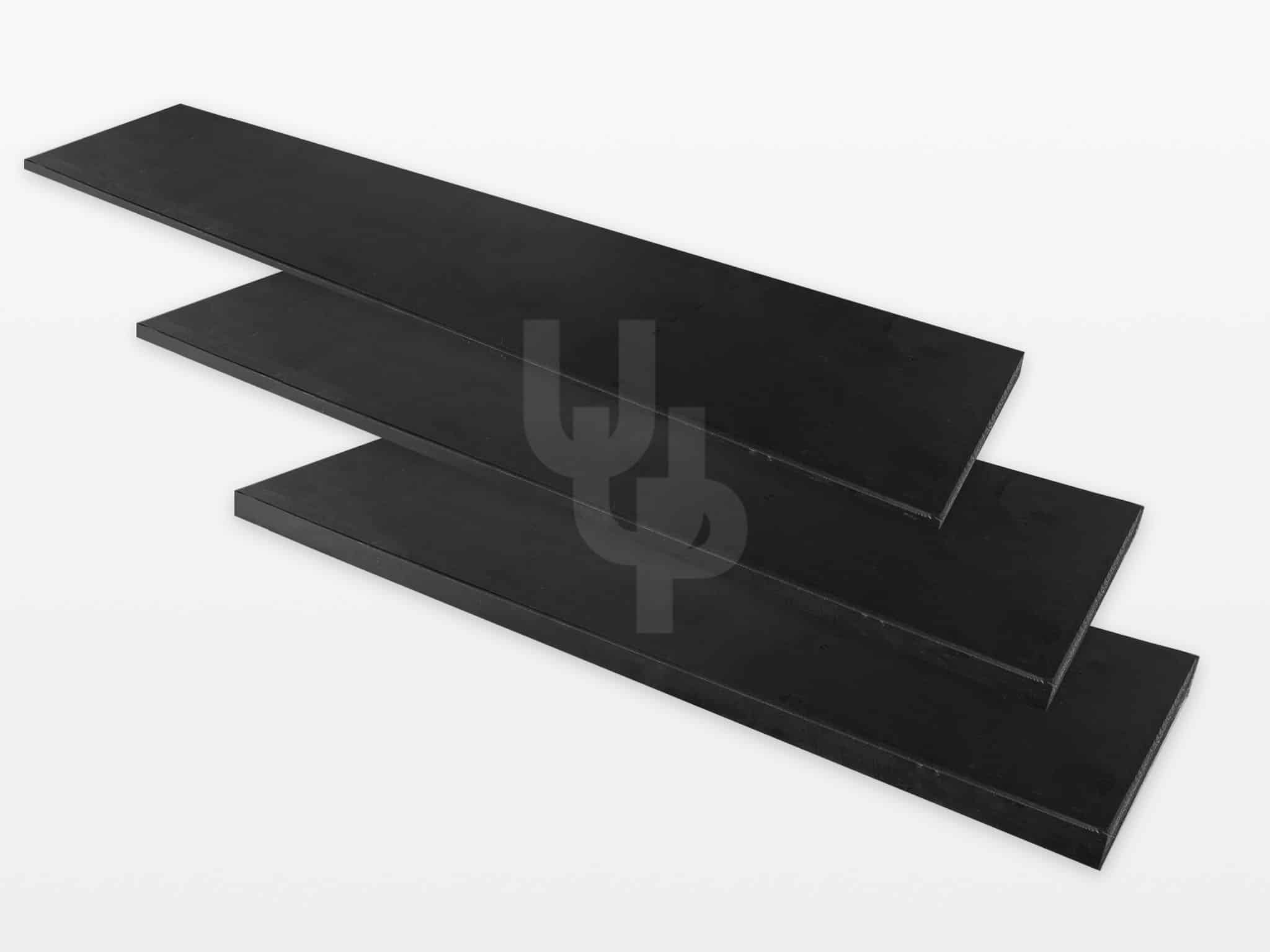

Snow plowing using blade with rubber edge

Mossy dell

Active member

Equipment
B2601 (2021) JD970 (1998) B2100 (1991) B6100E (1988)
Jul 20, 2020
285
137
43
sw VA
Front Blade1, 1-2-22.jpg

Inexperienced snow mover here who is dealing with snow in SW VA after two snowless winters
in a row. So I'm also rusty. I need advice, ideally from folks who use a snow plow blade with a rubber edge on asphalt.

On my Kubota B2601, I have a B2672 front mount on my loader arms with a 5-foot snow blade. There’s a 1”+ thick rubber edge bolted to the blade that sticks down a couple inches. I manually change the blade angle, so on my to-do list is installing a front cylinder!

Yesterday I reversed the rubber edge because the edge I'd used during 2-3 winters was worn almost to the blade's steel. I'm unsure if this is typical wear from plowing my asphalt driveway or from plowing our daughter's and neighbors' gravel driveways. I think both. But my question is really about my own driveway because I've learned to keep the rubber 1-2" above gravel. Our asphalt is in decent condition but with some cracks, bumps, and patched places.
Snow-Back up Drive 1-17-22.jpg

Our driveway is about 400' long and slopes up to the house at a 20%-plus angle. It takes a sharp turn toward the house at the top, and that curve is the steepest spot and the hardest to clear. Our little AWD cars wiggle going up with the slightest amount of snow. I suppose they'd do better with a snow pack, but delivery trucks wouldn't even attempt it. Ten days ago our propane delivery got aborted when the truck got stuck going up—after I'd plowed. I'd gotten the asphalt nicely clean, but afterward some white pines along the driveway dropped snow and ice. Just very thin patches in spots. And just in time for the truck to show up.

Given my driveway, am I correct in concluding I need to continue to use the rubber edge in contact with the asphalt and accept the resulting wear?

Second issue concerns technique—basically whether to use float or not. I haven't been and am not sure why. Whether I just forgot about it or didn't like the light front-end/steering issues. Maybe that was happening while plowing uphill. I only have 25 hp so can't move much going uphill, but I like to do a little to shorten the job slightly.

I've reviewed messages I saved from this forum and another on using float for plowing, and they were very divided and sometimes contradictory in the same message. The clearest recommendation I found was on Messick's YouTube channel on plowing with a bucket:

On asphalt, lower bucket to paving, level, put in float and scrape the surface clean.

On gravel, nudge bucket up a little and curl cutting edge up to keep from digging in.

What do you think about float based on your experience and about using the rubber in contact with the asphalt?
 

Dustball

Well-known member

Equipment
2016 B2650HSDC
Sep 15, 2023
483
349
63
Hudson, WI
The wear edges are consumable items, no way around that. That's why they're replaceable.

There's choices of materials depending the needs and wants from a wear edge and cost- the most common are steel, rubber, polyurethane, and UHMW. My preference is UHMW as it's very long lasting and doesn't damage asphalt or concrete.

It's a matter of finding a balance between how fast the edge wears and acceptable surface damage.
With rubber, you have no damage to asphalt but faster wear.

Here's an example of a vendor selling UHMW edges. https://www.goodworkstractors.com/product/uhmw-poly-plow-cutting-edge/
 
Last edited:
  • Like
  • Love
Reactions: 3 users

je1279

Well-known member
Lifetime Member

Equipment
LX2610 w/ 60" MMM, LP 72" Snow Plow, EA Wicked 55" Grapple, and Woods 60" BB
Dec 6, 2020
828
585
93
Upstate NY
I used a 1" rubber edge on my gravel driveway for a couple of years and it got chewed up pretty quickly. I now have a 1" polyurethane edge that I like much better. Cost more, but I will likely get ~5x the life out of it. As for float, I do not use it when plowing snow. I have my skid shoes set so the edge is a little over 1" off the ground. I lower the plow down until the skid shoes hit then give it a small bump or two up to retain steering. This combination has worked well for me.
 
Last edited:
  • Love
Reactions: 1 user

DustyRusty

Well-known member

Equipment
WAS BANNED FOR NSFW PICS
Nov 8, 2015
6,518
5,161
113
North East CT
I use a snowblower on the initial snow removal, and then use the plow with the metal edge in float mode and clear the pavement down to its black surface. I've been doing it this way for almost 2 decades and have yet to harm the asphalt. Before I had my Kubota I would clear the driveway with a 1997 Ford F250 4-wheel drive and a Fisher 8' plow with a steel cutting edge. I always angle the plow no matter the pushing machine and as a result, the cutting edge will wear at the edges. I turn the cutting edge over when it becomes worn and replace it when both edges are no longer usable.
If you are doing gravel driveways, until the gravel is frozen, no matter what you use it will be torn up.
 
  • Love
Reactions: 1 user

Mossy dell

Active member

Equipment
B2601 (2021) JD970 (1998) B2100 (1991) B6100E (1988)
Jul 20, 2020
285
137
43
sw VA
The wear edges are consumable items, no way around that. That's why they're replaceable.

There's choices of materials depending the needs and wants from a wear edge and cost- the most common are steel, rubber, polyurethane, and UHMW. My preference is UHMW as it's very long lasting and doesn't damage asphalt or concrete.

It's a matter of finding a balance between how fast the edge wears and acceptable surface damage.
With rubber, you have no damage to asphalt but faster wear.

Here's an example of a vendor selling UHMW edges. https://www.goodworkstractors.com/product/uhmw-poly-plow-cutting-edge/
Dustball, the UHMW edge sounds great. I may upgrade when I go through this new edge of my rubber lip.
 

Mossy dell

Active member

Equipment
B2601 (2021) JD970 (1998) B2100 (1991) B6100E (1988)
Jul 20, 2020
285
137
43
sw VA
I used a 1" rubber edge on my gravel driveway for a couple of years and it got chewed up pretty quickly. I now have a 1" polyurethane edge that I like much better. Cost more, but I will likely get 3-4x the life out of it. As for float, I do not use it when plowing snow. I have my skid shoes set so the edge is a little over 1" off the ground. I lower the plow down until the skid shoes hit the ground then give it a small bump or two up to retain steering. This combination has worked well for me.
Thanks, man. Do you recall the brand or source for your polyurethane edge?
 
  • Like
Reactions: 1 user

je1279

Well-known member
Lifetime Member

Equipment
LX2610 w/ 60" MMM, LP 72" Snow Plow, EA Wicked 55" Grapple, and Woods 60" BB
Dec 6, 2020
828
585
93
Upstate NY
Thanks, man. Do you recall the brand or source for your polyurethane edge?
Here is a link to the polyurethane edges. They are a bit cheaper than the UHMW ones.

 
  • Like
  • Love
Reactions: 1 users

lynnmor

Well-known member

Equipment
B2601-1
May 3, 2021
1,708
1,504
113
Red Lion
Search for UHMW online and you will find suppliers of bar stock that have a reasonable price. All you need to do is drill the bolt holes and that is very easy. I bought a used setup same as you have except it has the hydraulics. It was one year old and the rubber was spent. With the mild winters we have had, I have been using my garden tractor with a 4 foot UHMW edge and it has been lasting for years.
 
  • Like
Reactions: 1 user

SDT

Well-known member

Equipment
multiple and various
Apr 15, 2018
3,432
1,200
113
SE, IN
View attachment 146503
Inexperienced snow mover here who is dealing with snow in SW VA after two snowless winters
in a row. So I'm also rusty. I need advice, ideally from folks who use a snow plow blade with a rubber edge on asphalt.

On my Kubota B2601, I have a B2672 front mount on my loader arms with a 5-foot snow blade. There’s a 1”+ thick rubber edge bolted to the blade that sticks down a couple inches. I manually change the blade angle, so on my to-do list is installing a front cylinder!

Yesterday I reversed the rubber edge because the edge I'd used during 2-3 winters was worn almost to the blade's steel. I'm unsure if this is typical wear from plowing my asphalt driveway or from plowing our daughter's and neighbors' gravel driveways. I think both. But my question is really about my own driveway because I've learned to keep the rubber 1-2" above gravel. Our asphalt is in decent condition but with some cracks, bumps, and patched places.
View attachment 146504
Our driveway is about 400' long and slopes up to the house at a 20%-plus angle. It takes a sharp turn toward the house at the top, and that curve is the steepest spot and the hardest to clear. Our little AWD cars wiggle going up with the slightest amount of snow. I suppose they'd do better with a snow pack, but delivery trucks wouldn't even attempt it. Ten days ago our propane delivery got aborted when the truck got stuck going up—after I'd plowed. I'd gotten the asphalt nicely clean, but afterward some white pines along the driveway dropped snow and ice. Just very thin patches in spots. And just in time for the truck to show up.

Given my driveway, am I correct in concluding I need to continue to use the rubber edge in contact with the asphalt and accept the resulting wear?

Second issue concerns technique—basically whether to use float or not. I haven't been and am not sure why. Whether I just forgot about it or didn't like the light front-end/steering issues. Maybe that was happening while plowing uphill. I only have 25 hp so can't move much going uphill, but I like to do a little to shorten the job slightly.

I've reviewed messages I saved from this forum and another on using float for plowing, and they were very divided and sometimes contradictory in the same message. The clearest recommendation I found was on Messick's YouTube channel on plowing with a bucket:


What do you think about float based on your experience and about using the rubber in contact with the asphalt?
I had the same Kubota FEL mounted plow with hydraulic angle option on my B3350. Mine had the Kubota supplied hard rubber cutting edge to protect my asphalt driveways. Never used on crushed rock surfaces.

I always used float when plowing and carefully adjusted the skid shoes to limit wear.

The hard rubber (or Poly) cutting edges do a good job clearing asphalt or concrete surfaces in float but do wear rapidly and are expensive.

One can adjust the edge downward a time or two and it is vertically reversible, but they tend to wear more on the ends, resulting in a convex edge.
 
  • Like
Reactions: 1 user

GreX

Active member

Equipment
BX2380
Jan 8, 2023
185
132
43
Maine
A very cheap option, and what I've used the last three years, get a stick of Trex decking, and drill holes. Not sure how it will work on gravel, as our driveway is paved, but an option that for sure won't break the bank - since I'm using it on the bucket (only 4' wide) I was able to get two edges out of one 8' stick. And, you can go to HD or Lowes and pick it up anytime.
 
  • Like
Reactions: 2 users

trikepilot

Active member

Equipment
B2620HSD LA364/BH65 48SQ Bush Hog LP FDR1660 LP RB1560 B2672 42in forks 5ft box
Jul 18, 2020
158
200
43
Hardy, VA
Older post (Jan 2025), I know, but I found it when searching OTT for info and figured I'd add my $0.02 and questions to it here to keep it all in one place in the event that others are researching plastic/poly blade edges like me. Plus the OP is also in SWVA just like me!

I got in my first day of snow removal with a plow this past Sunday and it was a game changer. SOOOO much better than the bucket of the FEL!! But it has sent me down the rabbit hole of research on traction aids and plastic/poly blade edges.

20260201_122639.jpg


I did all my asphalt and concrete and I am sure when all the bits and pieces of snow/ice melt off, I am gonna find scratch marks everywhere. I had decent traction on my R4s but I know I will need to make it better. I’d like to avoid chains for cost, hassle, and pavement damage for now so I have ordered a tire groover that I will take to my R4s this weekend.

I am also deep into research on the relative merits of UHMW vs Polyurethane vs Rubber for the blade edge as I am headed back out this weekend to try and tackle the 0.6mi of gravel out to the road. I have used the split ABS pipe on my bucket in the past and I have one for my front blade that I plan to try this weekend in an effort to avoid major gravel damage. I do have some general questions.

  • How wide do you cut a slit in the black ABS pipe? I ran one pass with the circ saw and gently coaxed the 60in pipe onto the blade edge. My blade is thick, maybe ½ to 5/8 in thick – way thicker than my FEL bucket. This black ABS pipe sat on the plow for maybe 3-4weeks unused and when I went out to use it last weekend, it was cracked on the leading edge – the edge 180deg from the slit. I can only surmise that the thick blade prying open the slit for a prolonged period put too much stress on the opposite side of the pipe and created stress fractures in the material. Is there any good rule of thumb on how wide the slit the ABS pipe relative to blade thickness to optimize its durability while still making it want to stay on the blade?
  • When putting on a plastic blade edge – either UHMW or poly – is it standard to bolt it on top of the existing steel blade or to take off the steel blade and use only the new plastic edge?
Below is what I am contemplating currently – none are inexpensive except the Amazon Chinesium version that with added shipping gets less enticing on a cost:value ratio.

https://www.goodworkstractors.com/product/uhmw-poly-plow-cutting-edge/

https://store.fallline.com/snow-rem...6359af0c4&utm_content=Polyurethane Plow Edges

https://www.polyurethanesnowplowblades.com/product/snow-plow-blades-holes-not-included/

https://www.amazon.com/Cutting-Indu...fac89323e2f9dd9f0f&qid=1770122984&sr=8-5&th=1


I am probably not going to do anything about the plastic plow edge this winter as we don’t get alot of regular ice/snow so I will gamble that I won’t need to deal with it again this year. I want to adequately research and make the best decision as there are widely varying reports of performance and durability along with some pretty outrageous costs. If I can gather enough info to convince me that either UHM or polyurethane is the way to go, I can watch for some offseason sales.


But this coming weekend I am most definitely trying the Trex hack I ran across here and elsewhere online. A 12ft piece is $20 at my local bigbox store. This gives me two 5ft pieces to make it work for pennies on the dollar.
 

GreensvilleJay

Well-known member

Equipment
BX23-S,57 A-C D-14,
Apr 2, 2019
13,390
6,010
113
Greensville,Ontario,Canada
Your snowplow should have 'feet', 'pads' whatever locals call them. Adjust to say 1" above the ground
Now use 'float' and go slow enough to allow the plow to float and follow the road surface.
That's how my CJ-5 was setup for years, moved mountains of snow.
 

chim

Well-known member

Equipment
L4240HSTC with FEL, Ford 1210
Jan 19, 2013
3,000
2,473
113
Near Lancaster, PA, USA
Stop and pick up one of those "alligators" along the road. You know those tread portions of truck tires that commonly get shed and left behind. Cut it a couple inches longer than the blade width (this keeps edges from digging in). Cut it wide enough so it sticks down maybe 1-1/2" below the cutting edge and can be reversed if it ever wears out and . Poke holes for the bolts that mount the steel cutting edge. Sandwich the tire tread between the cutting edge and moldboard. May need longer bolts.

We did this to a rear scraper blade at work and it was used for years without wearing out. We had a combination of gravel and blacktop with potholes and things that stuck up like old fence post stubs and places where some brain surgeon used concrete to "repair" potholes in blacktop. It was flexible enough to glide over things that previously snagged the blade.

Cutting it is a dirty, smoky and a little time-consuming. We tried a few different power tools and I think the angle grinder with a cutoff wheel worked a little better than the circular saw with an old carbide blade. Either way it helps if you don't cut full depth all at once and can spread the kerf while cutting. With the circular saw we had the blade get hot enough it started to get wavy when attempting a full depth cut.
 
  • Like
Reactions: 1 user

RCW

Well-known member
Lifetime Member

Equipment
BX2360, FEL, MMM, BX2750D snowblower. 1953 Minneapolis Moline ZAU
Apr 28, 2013
10,241
7,157
113
Chenango County, NY
Like @lynnmor says, UHMW is nearly indestructible.

Little different application, but I lined the shoes on my snowblower with 1/2" UHMW several years ago. Made them reversible to accommodate wear.

There's no need to accommodate wear in my application, because there is no wear. 😲

I think for your blade there would be wear, but UHMW is very durable stuff. Not cheap by far, but good stuff.
 

Dustball

Well-known member

Equipment
2016 B2650HSDC
Sep 15, 2023
483
349
63
Hudson, WI
Like @lynnmor says, UHMW is nearly indestructible.

Little different application, but I lined the shoes on my snowblower with 1/2" UHMW several years ago. Made them reversible to accommodate wear.

There's no need to accommodate wear in my application, because there is no wear. 😲

I think for your blade there would be wear, but UHMW is very durable stuff. Not cheap by far, but good stuff.
I retrofitted a couple of my wide pusher snow shovels (30 inch and 36 inch) with thin UHMW wear bars 19 years ago- wear bars are still going strong.